
 Türkçe
 Français
 Deutsch
A dental crown is a personalized restoration treatment applied to protect and restore teeth that have lost their structural integrity due to decay, fracture, or excessive material loss. Made from durable materials such as porcelain or zirconium, these restorations completely cover the visible part of the tooth like a helmet, protecting it from external factors. This treatment not only restores the tooth’s original shape, color, and chewing function but also provides an aesthetic appearance in smile design applications. A dental crown is a reliable method that meets both functional and aesthetic needs, extending the life of the tooth.
Dr. Dt. Ömer Atar
He completed his primary, secondary, and high school education in Trabzon and graduated from Marmara University Faculty of Dentistry in 2000, where he began his studies in 1994.
Immediately after graduation, he worked in the field of Prosthetic Dentistry at Marmara University, focusing on Metal-Free Aesthetic Systems and Cosmetic Dentistry.
He received his PhD and specialization degree in 2007 for his studies on the application of implants, the construction and control of implant-supported prostheses in patients treated with distraction osteogenesis.
Dr. Ömer ATAR, who closely follows professional innovations, has participated in many seminars and courses both domestically and abroad, and is a member of EDAD (Aesthetic Dentistry Academy Association).
What Is a Dental Crown and What Does It Do?
You can think of a dental crown as a “protective garment” tailored specifically for a worn-out tooth. Just as you would create a custom case to protect a valuable item, a dental crown is designed to protect a weakened tooth from external factors and hold it together as one piece. It completely covers the visible part of the tooth above the gum line, giving it a new and solid outer surface. This ensures that you can safely perform essential functions such as chewing while maintaining the aesthetic integrity of your smile.
When a crown is placed over a tooth, that tooth essentially gains a second chance. The crown encases the tooth like a helmet, halting the progression of cracks, preventing fractures, and safeguarding the remaining healthy tooth structure. The functions of a dental crown are quite diverse. First, it strengthens a weak tooth. It provides vital protection for teeth that have become thin after large fillings or fragile after root canal treatment. Secondly, it restores broken or severely worn teeth to their original form, bringing chewing function back to normal. It also plays an important aesthetic role; it improves the appearance of discolored, misshapen, or gapped teeth, giving you a confident smile. Finally, crowns serve essential purposes such as supporting dental bridges or being placed on top of dental implants to replace missing teeth. In short, a crown is a versatile treatment solution that supports a tooth from both the inside and outside, extends its lifespan, and enhances its aesthetics.
When Is Dental Crown Treatment Needed?
The decision to place a dental crown is usually made when a tooth has lost too much structure to be repaired with a simple filling. This treatment is necessary to protect the tooth in the long term and maintain its function. The most common situations that require dental crown treatment are:
- Large cavities that cannot be repaired with fillings
- Teeth that are fractured or cracked due to trauma
- Teeth weakened and made brittle after root canal treatment
- Teeth that are excessively worn down due to teeth grinding or clenching
- Permanent and severe discoloration that cannot be corrected by whitening
- Congenital or acquired aesthetic deformities
- Used as abutment teeth in dental bridges
- Superstructure of dental implants replacing missing teeth
The common feature of these conditions is that the structural integrity of the tooth is compromised. The crown eliminates this risk by holding the tooth together and evenly distributing the chewing forces applied to it, preventing further damage. Therefore, when recommended by your dentist, crown treatment is one of the most important steps you can take to save the tooth.
How Many Types of Dental Crowns Are There and Which Is the Best?
Dental crowns vary depending on the material used to produce them, and each material has its own characteristics, advantages, and disadvantages. There is no single “best” crown; the right crown is determined by the condition of your tooth, your aesthetic expectations, your budget, and your dentist’s assessment. Let’s take a look at the most common types of dental crowns together.
Porcelain-Fused-to-Metal (PFM) Crowns
These crowns are a classic option that has been used safely in dentistry for many years. They consist of a metal substructure that provides strength on the inside and an aesthetic porcelain layer on the outside that mimics the natural color of the tooth:
The advantages of these crowns include:
- High durability
- Long-lasting use
- More economical compared to other aesthetic options
However, some disadvantages may include:
- The risk of forming a gray line on the gum over time
- Does not transmit light like a natural tooth
- Rare possibility of metal allergy
All-Ceramic or Porcelain Crowns
These crowns are made entirely of reinforced ceramic without any metal substructure. They are often preferred for front teeth where aesthetics are most important.
The most prominent advantages of this crown type are:
- Excellent aesthetics and natural appearance
- Reflects light like natural enamel
- High biocompatibility (tissue-friendly)
Its disadvantages can be listed as follows:
- Can be more fragile compared to metal-supported crowns
- Not usually the first choice for back molars
Zirconium-Supported Porcelain Crowns
In this modern crown type, the metal framework is replaced with a highly durable white-colored zirconium material. This zirconium core is covered with aesthetic porcelain, offering both strength and beauty together.
The main advantages of zirconium crowns include:
- Durability comparable to metal
- Natural and aesthetic appearance
- No risk of allergy due to its metal-free structure
- Does not cause gum discoloration
The possible disadvantages are:
- Higher cost compared to other options
- Being a very hard material, it has the potential to wear opposing teeth
Monolithic Crowns (E-Max and Full Zirconium)
These are the most advanced crowns produced from a single block material using computer-aided systems (CAD/CAM). Since they are monolithic (single-layered), they have a very low risk of fracture.
- E-Max (Lithium Disilicate): Stands out with its light-transmitting and aesthetic properties. It provides results indistinguishable from natural teeth, especially in the front region.
- Full Zirconium: Produced entirely from a single block of zirconium without porcelain layering. It is almost unbreakable, making it ideal for patients who grind their teeth and for back molars.
When deciding which crown is suitable for you, your dentist will consider the location of your tooth in the mouth, your gum health, aesthetic expectations, and habits such as teeth grinding to offer the most appropriate options.
Contact us for detailed information and appointments about treatments!
What Are the Stages of Dental Crown Treatment?
Dental crown treatment is a precise and careful process usually completed in two main sessions. Contrary to common concerns, it is neither painful nor difficult. Thanks to modern anesthesia techniques, all procedures are performed comfortably. The treatment process progresses step by step as follows:
- First Appointment: Preparation and Impression
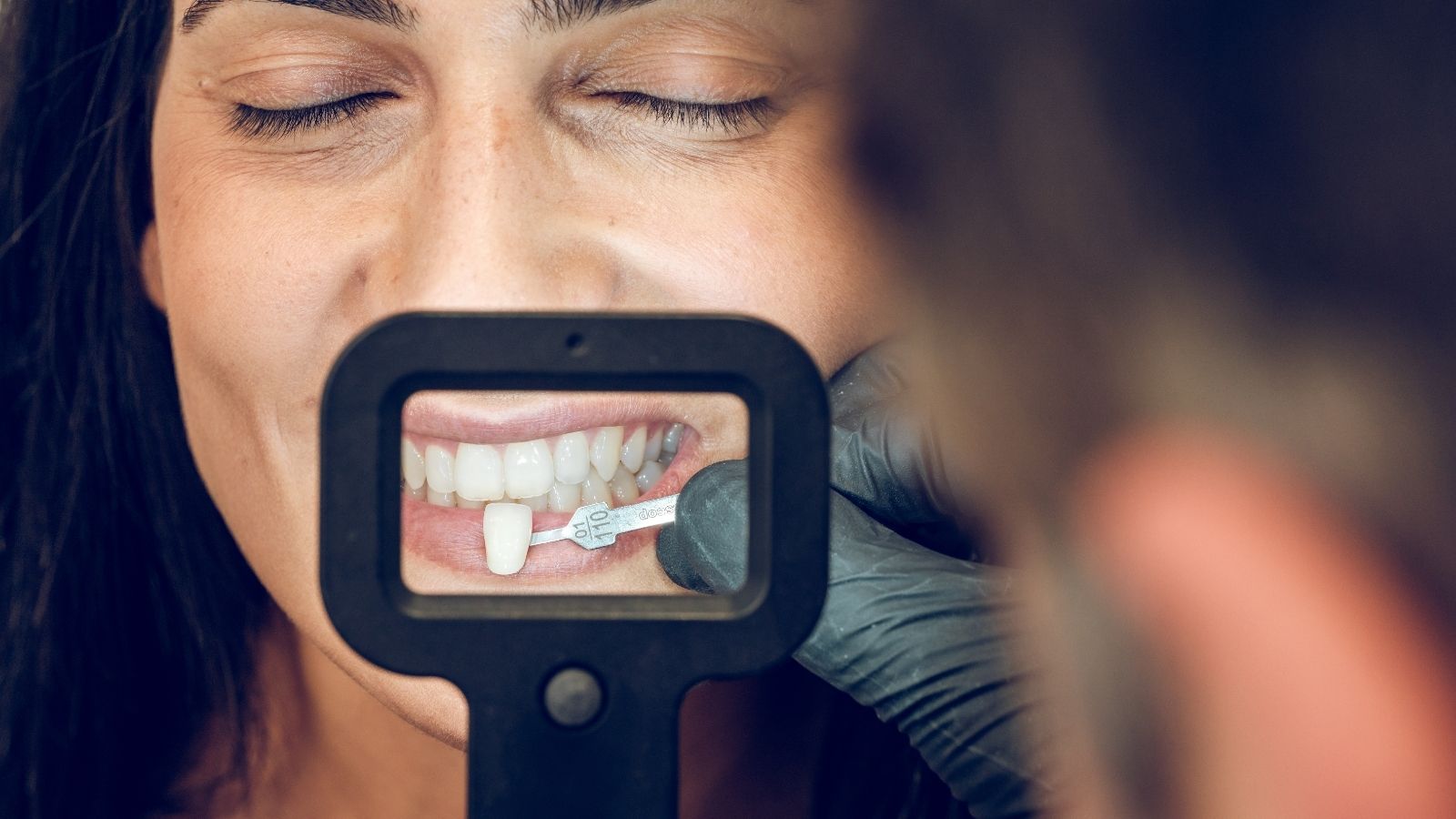
This first session is the most critical stage, where the foundation of the treatment is established. The tooth to be crowned and its surrounding area are first completely numbed with local anesthesia, ensuring you feel nothing during the procedure. Then, your dentist carefully and precisely reshapes the tooth from all surfaces so that the crown can fit perfectly. This reduction process is not to harm the tooth but to create space for the protective cap to be placed on top. Once the tooth is prepared, an accurate impression of the tooth and adjacent teeth is taken. This impression can be obtained either traditionally with a putty-like material or with intraoral digital scanners used in modern clinics. Afterwards, the natural shade of your tooth is determined with the help of a color scale to ensure the crown matches the surrounding teeth. At the end of this session, a temporary crown is placed to protect the prepared tooth from sensitivity and to maintain its aesthetic appearance.
- Second Appointment: Fitting and Cementation
About a week later, when your custom-made permanent crown arrives from the laboratory, your second appointment is scheduled. During this session, your dentist removes the temporary crown and cleans the underlying tooth. The permanent crown is then carefully tested before being cemented. During this fitting, your dentist checks whether the crown fits properly, the margin adaptation, contact with adjacent teeth, and occlusion with the opposing tooth. Minor adjustments are made if necessary. Once everything is perfect, the crown is permanently bonded to the tooth using a special dental adhesive (cement). Any excess adhesive is cleaned, final checks are made, and the procedure is complete. You can now safely enjoy your new, strong, and aesthetic tooth.
How Should Dental Crowns Be Cared For and How Long Do They Last?
With proper and regular care, dental crowns can serve you smoothly for many years — even decades. While the average lifespan of a crown is said to be between 5 and 15 years, this duration entirely depends on your personal oral hygiene habits. The most important point to remember is this: the crown itself does not decay since it is made of materials such as ceramic or metal, but the natural tooth beneath it and the surrounding gums remain susceptible to cavities and gum disease. The most common reason for shortened crown lifespan is decay that begins at the margin between the crown and the gum due to plaque buildup.
The basic maintenance steps to extend the life of your crown and maintain optimal oral health are no different from caring for your natural teeth:
- Brush your teeth at least twice a day with fluoride toothpaste.
- Pay special attention to cleaning the line where the crown meets the gum.
- Use dental floss or an interdental brush daily.
- Do not neglect cleaning between the crown and neighboring teeth.
- Avoid biting very hard objects such as ice or nutshells.
- Be cautious with sticky and hard candies.
- If you have a habit of teeth grinding, use the night guard recommended by your dentist.
- Visit your dentist for regular check-ups every six months.
By making this simple yet effective care routine part of your life, you can be sure that your crown will serve you functionally and aesthetically for many years. Good maintenance is the key to protecting not only your crown but your entire oral health.
Contact us for detailed information and appointments about treatments!
What Problems Can Occur After a Dental Crown?
Although dental crown treatment is a highly successful and reliable procedure, as with any medical intervention, rare complications may occur. Most of these issues are temporary and can be easily resolved with your dentist’s intervention. The important thing is to consult your dentist promptly if you notice any abnormalities. Possible problems that may occur after a crown procedure include:
- Temporary sensitivity to hot and cold in the first few days after treatment
- A feeling of height during chewing that requires adjustment
- Minor fractures or cracks in the porcelain surface
- Loosening of the crown due to gradual dissolution of the adhesive
- Complete dislodgement of the crown due to decay of the underlying tooth
- Dark gum line, especially in metal-supported crowns
- Very rare allergic reactions to metal alloys
If you experience any of these problems, there is no need to worry. For example, mild sensitivity usually resolves on its own within a few weeks. However, if your crown feels high, it can be easily corrected with a simple adjustment. If your crown becomes loose or falls out, it is important to bring it to your dentist without delay — it can often be re-cemented easily. Remember, regular check-ups and good oral hygiene minimize the risk of such problems.
Are There Alternatives to Dental Crown Treatment?
Although a dental crown is one of the most ideal and permanent solutions for restoring a severely damaged tooth, it is not the only option. Depending on the size, location, and type of problem, different treatment alternatives may be considered. In dentistry, the fundamental principle is always to choose the most conservative approach — the one that preserves the most natural tooth structure. In this context, the main alternatives to crown treatment include:
- Inlay and Onlay Porcelain Fillings
- Laminate Veneer (Porcelain Veneer)
- Composite Bonding (Aesthetic Filling)
- Tooth Extraction followed by Implant or Bridge Treatment