
 Türkçe
 Français
 Deutsch
Teeth whitening is a professional smile-aesthetics procedure that removes intrinsic discolorations that develop over time within the enamel and dentin layers by using special whitening agents, making the teeth’s existing natural shade several tones lighter. This process goes beyond cleaning the tooth surface, targeting discolorations in the deeper layers of the tooth to deliver a brighter, more vibrant, and healthier smile. Applied in a controlled manner without damaging the tooth structure, this method addresses esthetic concerns and aims to help the individual feel more confident with their smile.

Dr. Dt. Ömer Atar
He completed his primary, secondary, and high school education in Trabzon and graduated from Marmara University Faculty of Dentistry in 2000, where he began his studies in 1994.
Immediately after graduation, he worked in the field of Prosthetic Dentistry at Marmara University, focusing on Metal-Free Aesthetic Systems and Cosmetic Dentistry.
He received his PhD and specialization degree in 2007 for his studies on the application of implants, the construction and control of implant-supported prostheses in patients treated with distraction osteogenesis.
Dr. Ömer ATAR, who closely follows professional innovations, has participated in many seminars and courses both domestically and abroad, and is a member of EDAD (Aesthetic Dentistry Academy Association).
What Types of Discoloration Create the Need for Teeth Whitening?
We would all like our teeth to remain as white as a blank canvas, but time and lifestyle leave their marks on that canvas. Understanding the reasons behind the loss of natural tooth whiteness helps us grasp why whitening is needed. These causes are examined in two main groups based on the source of the stain: those originating from outside the tooth and those originating from within.
Extrinsic Discolorations
These are stains that adhere to the outer surface of the enamel and are generally the easiest to remove. Our daily habits play the starring role here. Think of enamel not as a perfectly smooth glass, but as a sponge with microscopic pores. The colored substances we consume fill these pores and gradually form stains.
The foods and beverages that most affect tooth color include:
- Coffee
- Tea (especially black tea)
- Red wine
- Cola and other carbonated, colored drinks
- Dark-colored fruits and their juices such as sour cherry, pomegranate, blackberry
- Soy sauce
- Beetroot
- Strongly colored spices such as turmeric
Tobacco use is also one of the most stubborn causes of extrinsic discoloration. The nicotine and tar in cigarettes adhere tightly to the tooth surface, forming a yellow-brown layer in a short time. Inadequate oral hygiene is another important factor. When teeth are not brushed regularly, the plaque that accumulates on them not only traps colored substances more easily, but also hardens over time into tartar (calculus), making teeth look dull and yellow.
- Intrinsic Discolorations
These discolorations occur not on the outer surface of the tooth but within its internal structure, and are therefore more difficult to remove. In other words, the tooth “changes color from the inside.”
Aging is the most natural part of this process. As the years pass, the protective outer enamel layer gradually thins. This thinning causes the color of the underlying, more yellow dentin layer to show through more. That’s why it’s quite normal for our teeth to look more yellow as we age.
Genetic factors also play a major role in determining tooth color. Just like our eye color, our tooth color is largely hereditary. Some people are born with whiter teeth, while others naturally have more yellow or grayish tones.
Certain medications used during childhood—when teeth are completing their development—can also lead to permanent discolorations. In particular, the “tetracycline” group of antibiotics is responsible for gray to brown, even band-like discolorations on teeth, which are the most difficult to treat.
A severe blow or accident to a tooth can damage and kill the living tissue (pulp) inside it. In such cases, because the tooth loses its blood supply, it gradually turns gray from within or even nearly black. A similar color change is frequently observed in root canal–treated teeth as well.
Is Teeth Whitening Suitable for Everyone?
Although teeth whitening is one of the most popular and safest applications in esthetic dentistry, it is not a “one-size-fits-all” procedure. For the treatment to be successful and trouble-free, the person’s oral health must meet certain criteria. Therefore, a detailed dental examination before the procedure is absolutely essential.
Who Are Ideal Candidates for Teeth Whitening?
In general, adults with good overall oral health who have yellow-toned discolorations on their teeth are the best candidates for whitening. Yellowing due to extrinsic factors (tea, coffee, smoking) and age-related color changes respond the fastest and most noticeably to whitening. Healthy gums, cavity-free teeth, and good oral-hygiene habits are the most important elements that increase the success of treatment.
Contact us for detailed information and appointments about treatments!
In Which Situations Is Teeth Whitening Not Recommended?
In some cases, the whitening procedure should be postponed or avoided.
- Pregnancy and breastfeeding
- Individuals under 18 (due to pulp sensitivity and incomplete development)
- Active dental caries or cracked teeth
- Advanced periodontal disease (periodontitis) or gum recession
- Severe enamel erosion
- Exposed and sensitive tooth roots
- Known allergy to whitening agents (peroxides)
- People with numerous crowns, porcelain veneers, or large fillings in the anterior region
In particular, performing whitening when there is tooth decay can allow the whitening gel to seep through the carious cavity to the pulp, causing severe pain and irreversible damage. Therefore, all existing oral and dental problems must be treated before whitening.
What Are the Professional Teeth Whitening Methods and How Are They Applied?
When it comes to teeth whitening, many different options may come to mind; however, the safest and most effective results are always achieved with professional methods applied under a dentist’s supervision. These methods differ completely from store-bought products in terms of material strength, application technique, and safety measures. Professional whitening falls into two main categories: in-office whitening performed in the clinic and at-home whitening performed under the dentist’s guidance.
- In-Office Teeth Whitening (Office Bleaching)
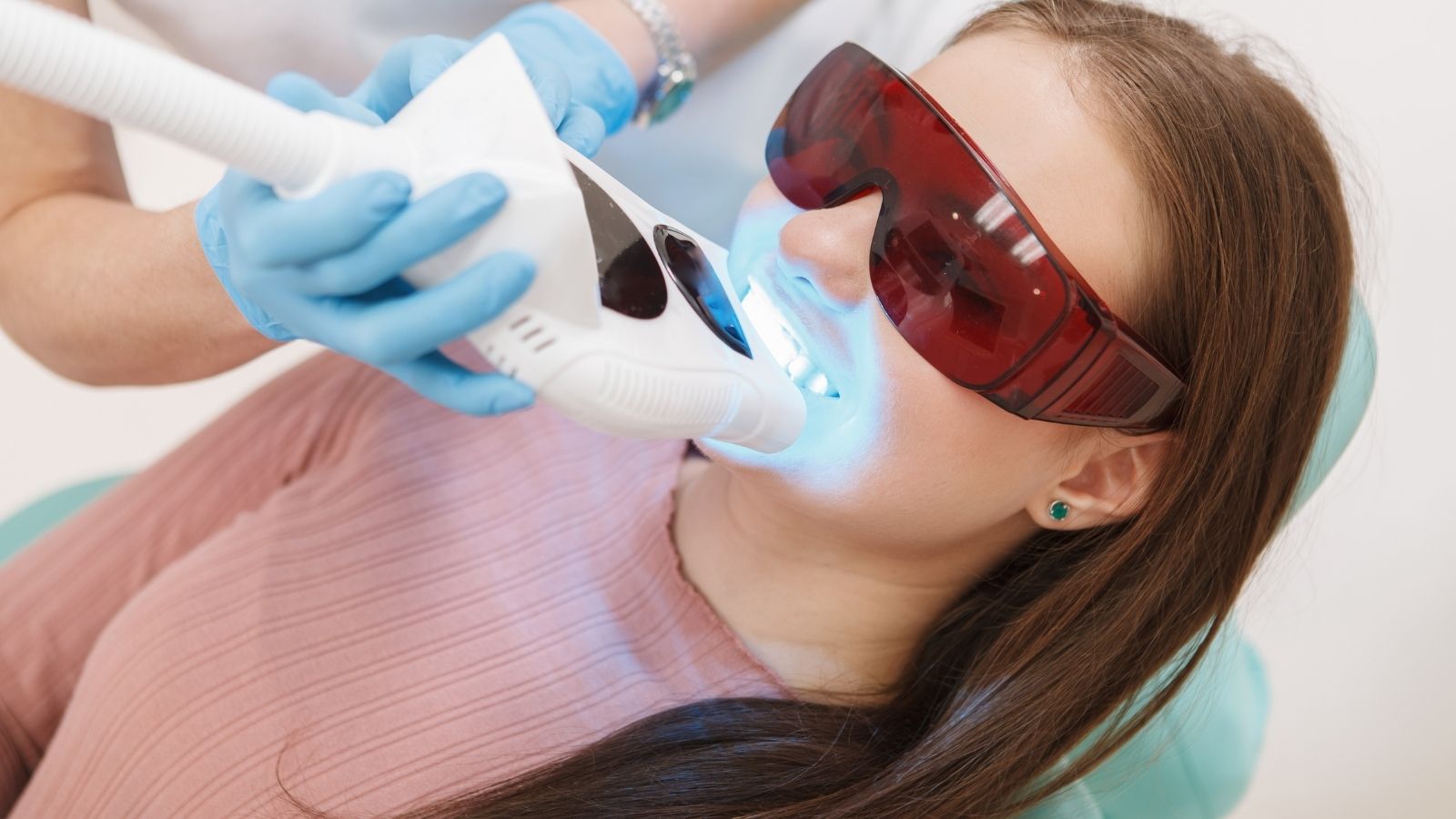
This method delivers the fastest results, and the entire procedure is completed in the dental chair in about an hour. Although commonly referred to as “laser teeth whitening,” what is usually used here is not a laser but a powerful LED or plasma light that activates the whitening gel.
The steps of the procedure require great precision. First, the lips and cheeks are gently retracted using a device called a retractor. Next comes perhaps the most critical step: protecting the gums. To prevent the high-concentration whitening gel from contacting and irritating the gums, a special light-cured protective barrier is applied to the junction where the teeth meet the gums. Acting like a gasket, this barrier completely isolates the gums. Once safety is ensured, a hydrogen peroxide–based whitening gel is carefully applied to the front surfaces of the teeth. Then, to enhance the gel’s effectiveness and accelerate the reaction, a special light source is applied to the teeth for about 15–20 minutes. Depending on the desired level of whiteness, this process is repeated in 2 or 3 cycles during the same session. When the procedure is finished, the protective barriers are removed and the result is immediately visible. In most cases, a 3–4 shade improvement can be achieved in a single session.
- At-Home Teeth Whitening (Home Bleaching)
In this method, the dentist prepares a kit with which the patient applies the treatment at home. Although it progresses more slowly than in-office treatment, the results are effective and long-lasting.
The process begins with the dentist taking an accurate impression of the patient’s mouth. Based on this impression, custom vacuum-formed clear trays that fit precisely over the teeth are fabricated in the laboratory. The trays’ being custom-made is crucial because it ensures that the gel contacts only the teeth and does not overflow onto the gums. The dentist provides syringes of carbamide peroxide–based whitening gels, which are lower in concentration than in-office gels. The amount of gel to be placed in the tray and the number of hours per day the tray should be worn are planned individually. Typically, trays are worn for 4 to 6 hours per day. Depending on the starting tooth shade and the desired outcome, treatment lasts an average of 10 to 14 days.
- Combined Teeth Whitening (The Most Effective Method)
As the name suggests, this method combines in-office and at-home whitening. It is preferred especially for very stubborn stains or for those who want to achieve the brightest possible shade. Typically, a single in-office session is performed in the clini
c setting to make a rapid start and boost motivation. Then, to further deepen the whiteness achieved and maximize its longevity, the treatment is continued at home for about one week. Combining the strengths of these two methods usually delivers the most satisfying and longest-lasting results.
What Are the Differences Between Professional Teeth Whitening and Over-the-Counter Products?
Whitening toothpastes, strips, pens, and gels that can be easily found in supermarkets, pharmacies, or online are quite popular. However, there is a world of difference between these products and professional applications performed under a dentist’s supervision. Knowing these differences is very important for protecting both your health and your expectations.
The most fundamental difference is the strength and concentration of the active ingredient used. Due to legal regulations, the concentration of whitening agents in professional systems is much higher than in store-bought products. This means they have the power to remove discolorations not only on the surface but also in the internal layers of the tooth. Store-bought products, on the other hand, due to their lower concentrations, generally can only lighten simple surface coffee/tea stains and cannot create a meaningful change in the tooth’s base color.
The second—and most important—difference is safety and professional control. Before whitening, the dentist examines you to determine whether you are a suitable candidate. If you have an unnoticed cavity, crack, or gum problem, an unsupervised product can make these issues much worse. In professional applications, the gums and soft tissues are carefully protected. With at-home whitening, custom trays prevent the gel from seeping onto the gums. In contrast, standard-size over-the-counter products (such as strips) may not fit your teeth properly, can irritate the gums, and can cause uneven gel distribution, leading to a wavy, patchy appearance on the teeth.
Finally, effectiveness and longevity are also key differences. The result you can achieve in an hour with a professional application might take weeks or even months of effort with over-the-counter products—if you can achieve it at all. Moreover, while the whiteness achieved with professional methods can last for years with proper care, the effect of store-bought products is generally much shorter-lived.
Contact us for detailed information and appointments about treatments!
Is Teeth Whitening Painful?
One of the most common questions patients ask is whether the procedure is painful. When performed correctly, teeth whitening is definitely not a painful procedure. No anesthesia is required during the process.
However, the most common and expected side effect of the procedure is temporary tooth sensitivity. Rather than pain, this can be described as a brief, sharp twinge—especially in response to cold air or cold drinks. The reason is that the whitening agent passes through microscopic channels called enamel tubules and mildly stimulates the tooth’s nerve tissue (pulp). This does not mean the tooth is damaged; it is simply a temporary reaction.
The level of sensitivity can vary greatly from person to person. Some people experience none, while others may notice it more. It is usually most intense within the first 24–48 hours after the procedure and then rapidly diminishes and disappears. Dentists can apply special desensitizing agents before or after the procedure and may recommend toothpastes formulated for sensitive teeth to minimize this sensitivity.
How Long Do Teeth Whitening Results Last?
How long the bright, white smile achieved after whitening will last depends entirely on your lifestyle and oral care. Unfortunately, whitening is not a permanent, lifetime procedure. Teeth are living tissues and will gradually discolor again over time.
On average, with good care, the longevity of professional whitening results ranges from 1 to 3 years. The most important factors that shorten or extend this period are dietary and oral-hygiene habits.
If you are a heavy coffee or tea drinker or a regular smoker, your teeth will naturally return to their pre-whitening shade sooner. Conversely, for someone who avoids highly colored foods and drinks, does not smoke, and is meticulous about oral care, the longevity of results can exceed 3 years.
To maintain the whiteness achieved and increase its durability, you can perform a one-night “touch-up” with your at-home trays every 6 months or once a year as recommended by your dentist. This will help keep your smile bright for many years.
What Should Be Considered After Teeth Whitening?
Post-procedure care is at least as important as the procedure itself for maximizing the success and longevity of whitening. The first 48 hours are especially critical—the teeth are most vulnerable to staining during this period. That’s because it takes time for the enamel pores opened during whitening to close again. During this time, a “white diet” should be followed. The rule is simple: avoid anything that could stain a white shirt.
Foods and drinks to avoid during the first 48 hours after the procedure include:
- Coffee and tea
- Red wine
- All carbonated and colored drinks (cola, sour cherry juice, etc.)
- Colored sauces such as tomato paste and ketchup
- Soy sauce and pomegranate syrup
- Chocolate
- Red meat
- Colored vegetables such as spinach and beetroot
- Dark-colored fruits such as cherry, blackberry, mulberry
- Strongly colored spices such as turmeric and curry
During this critical period, choose colorless foods such as milk and dairy products, white cheese, chicken and turkey breast, fish, potatoes, rice, and pasta (without colored sauces).
Also, strictly avoid cigarettes and other tobacco products during this time. The tar in cigarettes adheres to teeth much more rapidly during this sensitive period. Acidic beverages should also be avoided, as they roughen the enamel surface and facilitate staining. Following these simple rules will help you get the best return on your procedure and enjoy your white smile for longer.
Does Teeth Whitening Damage Tooth Enamel?
This is one of the most common—and justified—concerns among patients. To state clearly and definitively: professional teeth whitening performed under a dentist’s supervision, with the right diagnosis and technique, does not cause permanent damage to enamel or tooth structure. This topic has been the subject of countless scientific studies over the years, and the results have repeatedly confirmed the procedure’s safety.
Hydrogen peroxide or carbamide peroxide used in whitening works through a controlled chemical reaction. These substances do not abrade or dissolve the hard tissue of the tooth. What they do is oxidize and break down the organic color molecules (chromophores) lodged within the pores of the enamel and dentin, converting them into colorless compounds. It is essentially a sub-surface cleaning process that does not alter the tooth’s mineral structure.
However, this safety applies only to professional products and applications. Attempting to whiten teeth with uncontrolled products of unknown composition purchased online, or with “natural remedies” such as baking soda, lemon juice, or vinegar—acidic and abrasive substances—can cause irreversible scratches, erosion, and permanent damage to enamel. Such practices can actually make teeth look more yellow by thinning the enamel layer and revealing more of the underlying yellow dentin. Therefore, a medical procedure like teeth whitening should always be performed with the knowledge and supervision of a professional.
Why Doesn’t Whitening Affect Crowns and Fillings?
There is a very important point for those considering whitening who already have fillings, porcelain veneers, or crowns on the front teeth: whitening agents are effective only on natural tooth tissues.
Materials used in restorations—such as porcelain, composite resin, or zirconia—do not have a porous structure like human teeth. Their color is determined during fabrication and is fixed. Therefore, whitening gels cannot lighten or change the color of these materials.
So what happens in this case? If you have an old filling or crown on your front teeth and whitening is performed, your natural teeth will lighten while the filling or crown remains its original shade. This results in a noticeable and unaesthetic color contrast between your natural teeth and your restorations.
The correct approach in such situations is as follows: first complete the whitening procedure. After the procedure, wait about 2 weeks for the tooth color to stabilize. At the end of this waiting period, replace the old fillings, crowns, or veneers to match the new, whiter tooth shade achieved. In this way, full color harmony among all teeth is ensured and flawless esthetics are achieved. Therefore, when planning whitening, it is very important to evaluate your existing restorations together with your dentist.